Open Poker League23 min read
PokerGlicko: a Glicko rating built for poker
Published By FizzPoker
PokerGlicko is the rating behind FizzPoker’s Open Poker League. It keeps Glicko’s good idea — a rating plus an honest ± — and changes what counts: every hand in big blinds against what the ratings at the table expected, all-ins at equity, and a ladder sorted by what is proven. This is the full story: why textbook Glicko-2 ranks poker players backwards, every rule that replaced it, and the simulations behind each one.
Why a poker league needs its own rating
FizzPoker started as a way to play No-Limit Hold’em with friends in a browser, without ads, downloads or real money. Single games worked. What was missing was a reason to come back tomorrow and a way to see that you are getting better — the thing every competitive game solves with a ladder.
The model was StarCraft II. Its ladder runs on two levels: a matchmaking rating with an uncertainty underneath, and on top something a person can feel — seven leagues from Bronze to Grandmaster, tiers inside each league, placement, seasons and the small thrill of a promotion. Blizzard has never published the formula; Liquipedia describes a rating with an uncertainty value and compares it to Microsoft’s TrueSkill.
Poker already has rankings, but they measure something else. Results lists count money or cashes, which mixes skill with the size of the games someone can afford and with a great deal of luck. Trackers report big blinds won per 100 hands, which is the right unit but says nothing about who the hands were played against or how sure the number is. A league needs both: a fair number for every player, and an honest statement of how much that number can be trusted yet.
The obvious plan was to put the standard tool for that job, Glicko-2, under a StarCraft-style league. The rest of this article is about why that fails for poker and what the Open Poker League’s rating does instead.
From Elo to Glicko-2 in five minutes
The Elo system gives every player one number. Before a game it predicts a score from the difference between two ratings; after the game it moves both ratings by the surprise — the actual result minus the predicted one — times a constant, the K-factor. FIDE adopted it for chess in 1970.
Elo has no idea how sure it is. A newcomer’s first rating and a veteran’s thousandth are treated alike. Mark Glickman’s Glicko system (1995) added a rating deviation: a ± that is wide when little is known and narrows with evidence. A surprising result moves an uncertain rating a lot and a settled one a little, and a result against an uncertain opponent counts for less. Glicko-2 added volatility: how erratic a player’s results are, so a player who has suddenly improved can move faster.
| System | What it adds | Where it runs |
|---|---|---|
| Elo | One number per player, moved by the surprise of each result | FIDE and national chess federations |
| Glicko (1995) | A rating deviation: how sure the number is | Chess servers such as Chess.com |
| Glicko-2 (2001) | Volatility: how erratic a player’s results are | Lichess |
| TrueSkill | Teams and games with many players | Xbox matchmaking |
All of them share one assumption: a game ends in a result that says who did better — a win, a draw, a loss, or a finishing order. That is where poker parts ways.
Seven ways poker breaks Glicko
1. A hand is not a win or a loss
Nine pots of 2 big blinds and one of 100 make a 9–1 record and a loss of 82 big blinds. Poker skill is mostly about the size of the pots you win and lose, and a win/loss count throws the size away.
2. Luck is enormous
A single hand of 100-big-blind No-Limit Hold’em swings by about 10 big blinds (one standard deviation, measured in the simulations below), while a good player beats an average one by about 5 big blinds per 100 hands. The number of hands needed to pin a win rate down to ±5 bb/100 is (100 × 10 ÷ 5)² — about 40,000. A chess rating settles after a few dozen games; a poker rating needs tens of thousands of hands for the same confidence.
3. Many players share a hand
A table holds two to six people. Glicko can be bent to that by treating every pair at the table as a game, but the fifteen pairs of a six-seat hand are not fifteen independent results, and the lineup changes every few minutes as people come and go.
4. The table size changes the game
The same player wins more per hand heads-up than six-handed, and every hand swings more. A rating that ignores the table size confuses a heads-up specialist with a better player.
5. Players differ in variance, not just in skill
A maniac’s results swing far more than a nit’s. The same +20 big blinds tells you less about the maniac, and a rating that treats both alike lets the high-variance styles bounce around the top of the board.
6. There may be nobody to play with
A small site rarely has six people online at once. Something has to fill the seats, and whatever fills them must not bend the scale.
7. Chips can be given away
Two accounts can feed chips to each other far more easily than two chess players can throw games. A ladder that trusts every result invites exactly that.
How to test a rating nobody can check
On a real site, nobody knows anyone’s true skill, so nobody can say which rating ranks people better. The answer is a simulated poker room where true skill is known exactly. The FizzPoker rating lab is a toy No-Limit Hold’em engine with blinds, positions and all-ins, tables of two to nine, and six playing styles whose skill emerges from how they play rather than being typed in. Every simulated player’s true win rate against the players they actually met is computed exactly, hand-by-hand expectations included.
| Style | How it plays | True win rate |
|---|---|---|
| Tight-aggressive | Few hands, played hard | +7.6 |
| Loose-aggressive | More hands, still aggressive | +6.1 |
| Nit | Very few hands, rarely bluffs | −2.9 |
| Recreational | Plays for fun, mixed habits | −6.5 |
| Maniac | Bets and raises almost everything | −26.7 |
| Calling station | Calls far too often | −27.3 |
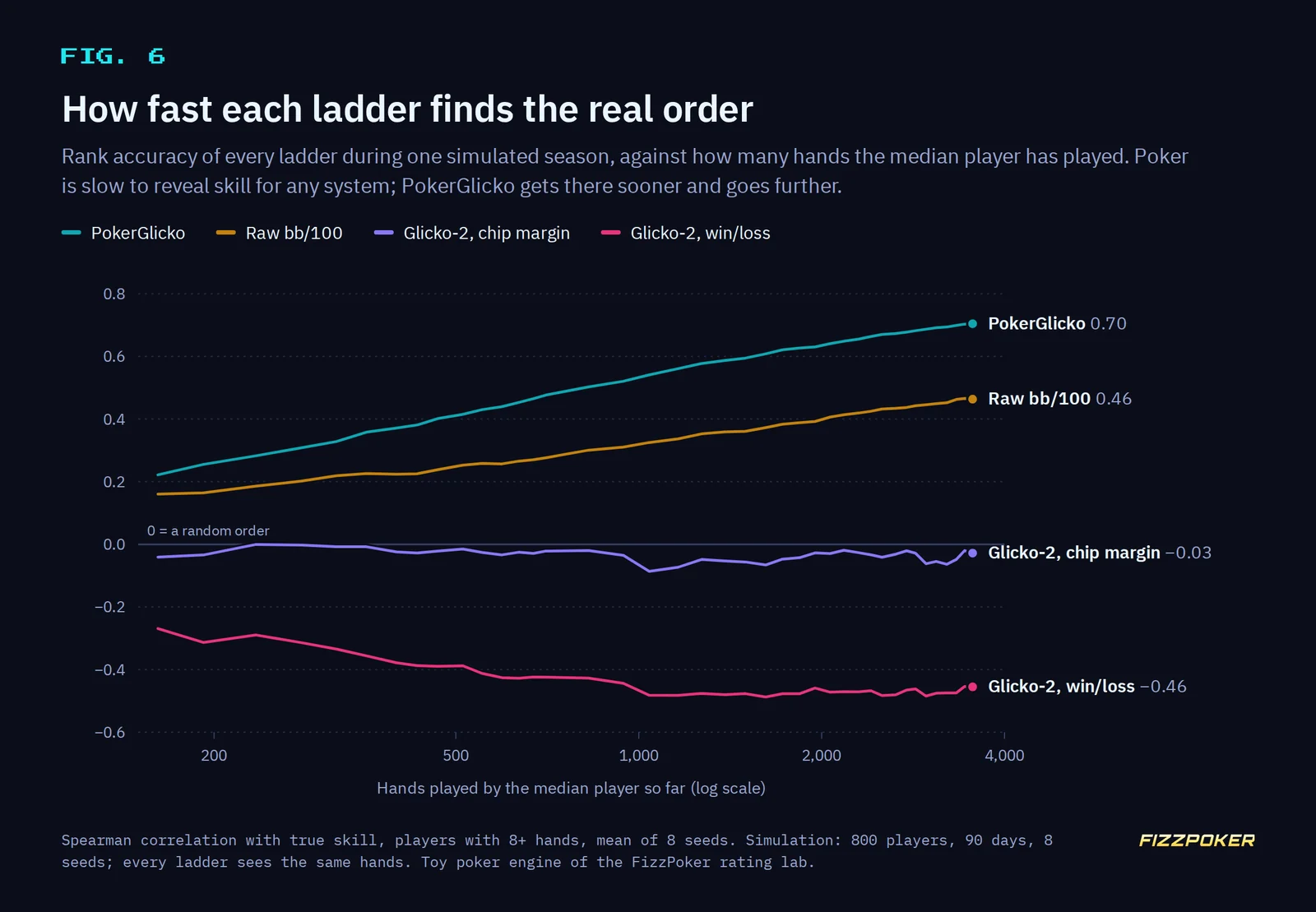
Every rating system is fed exactly the same hands. Accuracy is measured with Spearman’s rank correlation between a ladder and true skill: 1 means the ladder has players in the same order as their true skill, 0 a random order, −1 the reverse. The main run for this article has 800 players over a 90-day season at tables of two to six, repeated with 8 random seeds; the stress tests further down use 600 players over 60 days in worlds built to break particular rules.
One caveat applies to everything below: this is a toy engine, built to test rating systems. Expect the order of the systems to carry over to real play, not the decimals.
What textbook Glicko-2 does to poker
The first test was the obvious one: Glicko-2 with every pair of players at a table playing a “game” each hand, won by whoever won more chips. At mixed tables of two to six it ranked players backwards, with a rank accuracy of −0.46. Of its top 10% of players, 85% were calling stations and maniacs — the two styles that, in truth, lose about 27 big blinds per 100 hands.
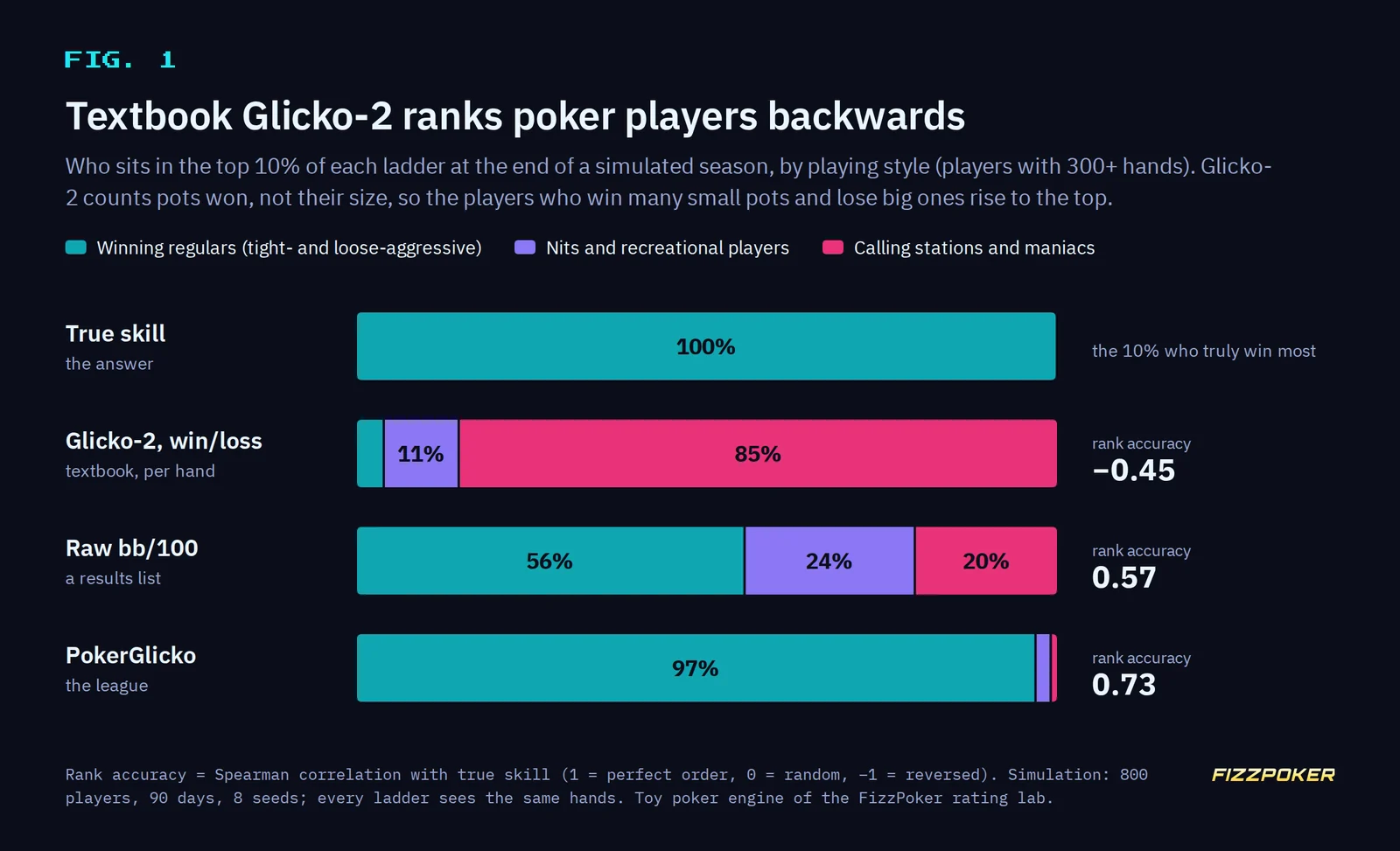
The reason is simple once you see it. Calling stations and maniacs are in a lot of pots, and they win a lot of small ones: the station wins at showdown against bluffs, the maniac wins every pot nobody contests. They lose the big ones. Glicko-2 counts the wins and never sees the size. How badly it fails depends on the table mix: at full six-seat tables only, its order was close to random (−0.07); with many heads-up tables it fell to −0.31, and at tables of two to nine to −0.47.
Feeding Glicko-2 the chip margin of each hand instead of win/loss — squashed into a score between 0 and 1 — only brought it to zero, a random order. The squashing bends the incentive, and Glicko’s idea of how much a single result can vary is wrong for chips.
PokerGlicko, rule by rule
PokerGlicko keeps Glicko’s core: a rating μ, an uncertainty φ that narrows with evidence, and an update weighted by how much was already known. Everything else is adapted to poker. Ratings are measured in big blinds won per 100 hands against the average active player. Measured one at a time, the rules fall into two groups.
Rule 1 — Score big blinds, not wins
Every hand counts as the big blinds a player won or lost, x, compared with what the ratings at the table expected:
m = γ[n]/100 · (μ_you − mean μ of the others)

γ for 2 to 6 players dealt:  1.70  0.95  1.00  1.02  1.00
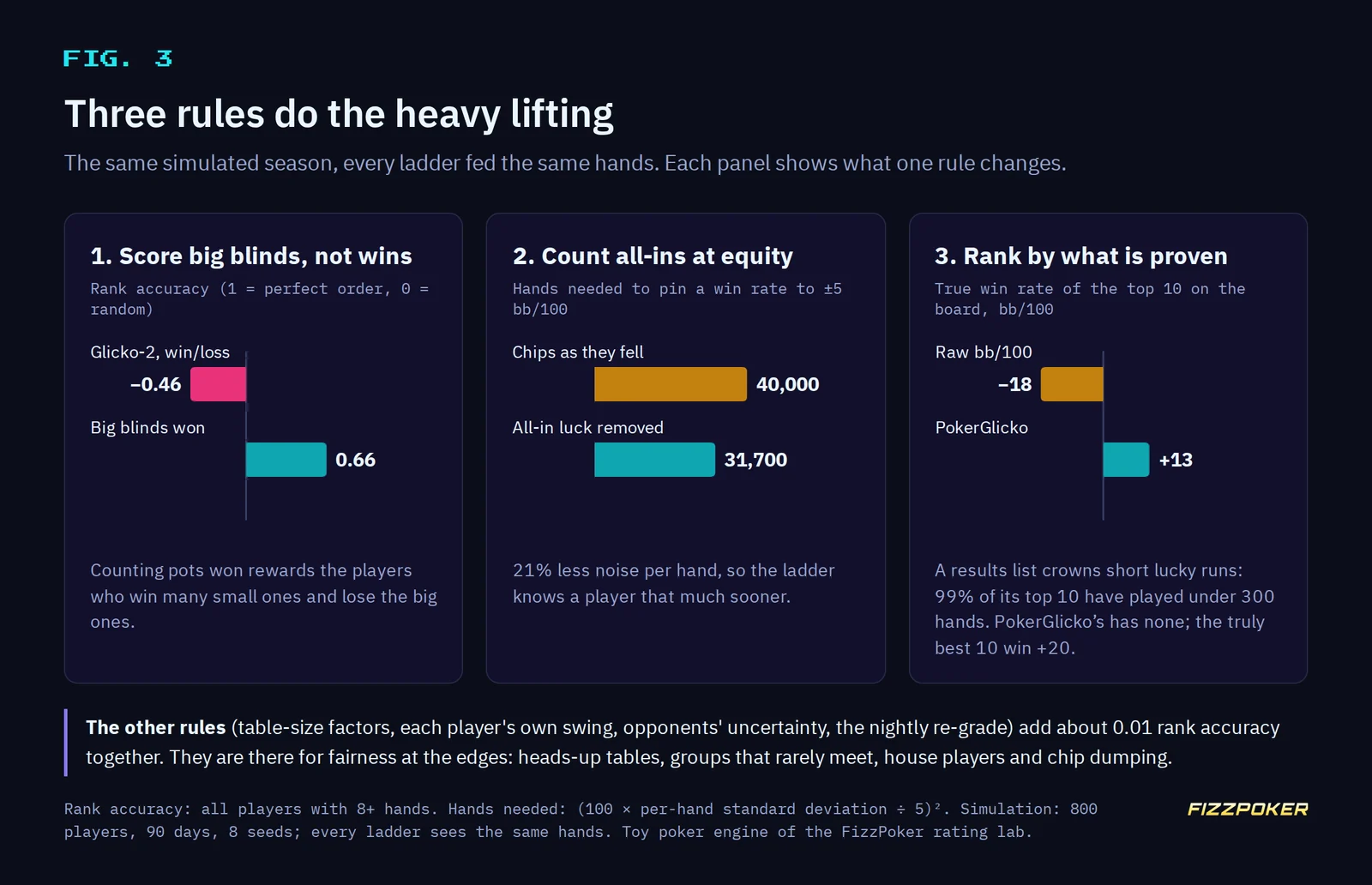
Breaking even against stronger players is a good result; breaking even against weaker ones is a bad one; doing exactly as expected moves nothing. The factor γ scales how much of a rating edge shows up per hand at each table size (rule 4). This one change does most of the work: rank accuracy goes from −0.46 to 0.66.
Rule 2 — Count all-ins at equity
When the money goes in before the river, each player is credited with their share of the pot at that moment, not with how the remaining cards fell. Poker trackers such as PokerTracker call this “all-in adjusted” winnings; the equity calculator shows the shares for any two hands.
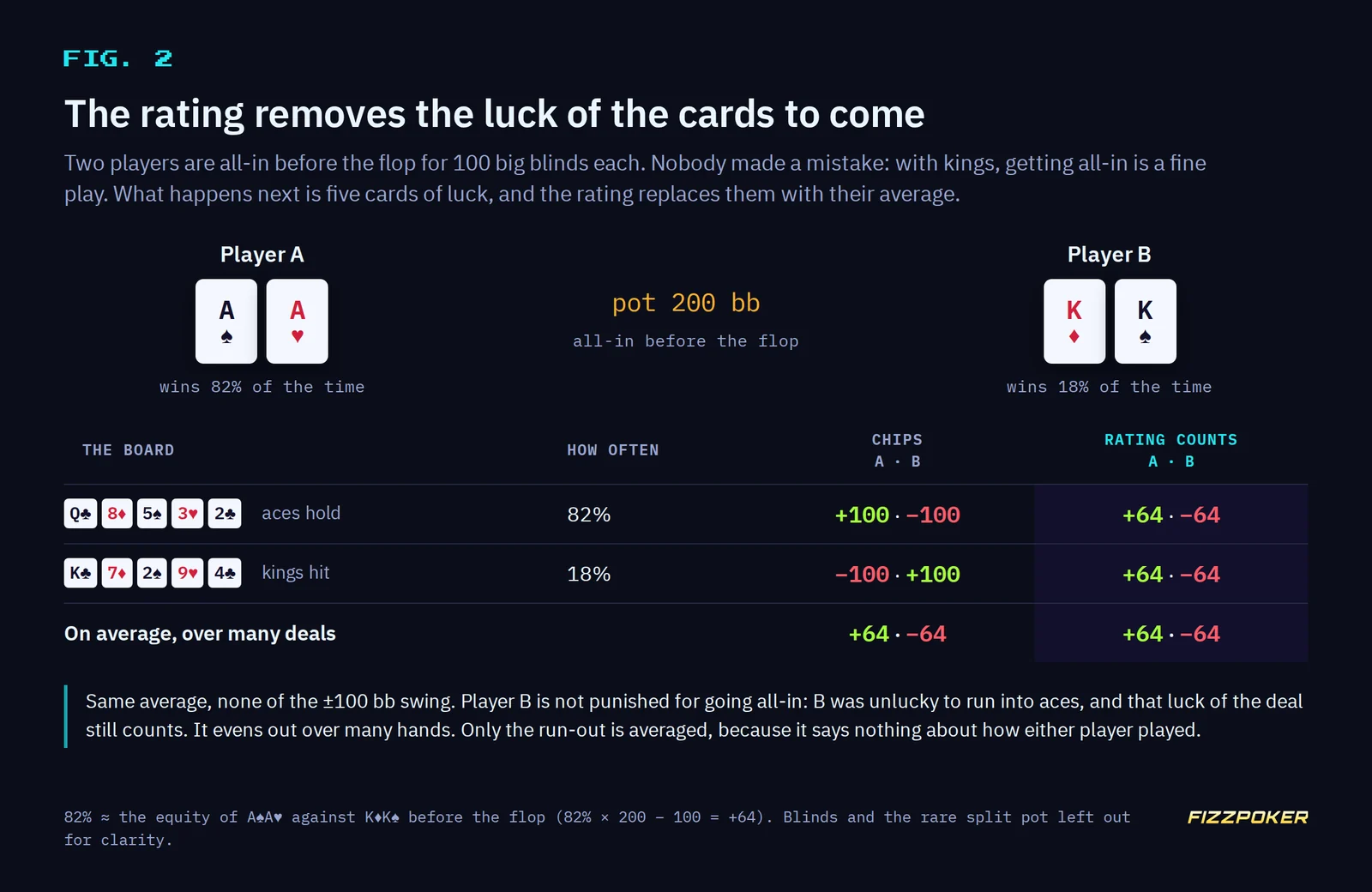
Nobody is punished for getting all-in. With kings, getting it in before the flop is a fine play; running into aces is luck of the deal, and that still counts — it evens out over many hands. Only the run-out, the five cards still to come, is replaced by its average, because it says nothing about how either player played. Before the flop the equity is sampled from 800 run-outs (about ±3 big blinds on a 200-big-blind pot, and unbiased); from the flop on it is exact.
In the simulation this removes about a fifth of the noise in every hand: 100 bb² of variance per hand as the chips fell, 79 with all-in luck removed. Hands needed scale with variance, so the ladder needs about 31,700 hands instead of 40,000 to pin a win rate down to ±5 bb/100.
Rule 3 — Rank by what is proven
The number on the badge is not the rating itself but a cautious version of it:
hidden rating = 1500 + 20 · (μ − μ_start − 3)
uncertainty   = 20 · φ
shown rating  = hidden rating − 0.75 · uncertainty
± on screen   = 2 · uncertainty

a new player: φ = 16 → shown 1,200 ± 640        100 points = 5 bb/100
A new player starts at exactly 1,200 and climbs as the ± narrows; a better player climbs faster. This is the rule that stops a results list’s worst habit. Ranked by raw big blinds per 100 hands, 99% of the top 10 in the simulation had played under 300 hands — lucky short runs whose true win rate was −18 bb/100. PokerGlicko’s top 10 had none of them and a true win rate of +13 (the truly best 10 were at +20). Ranking the same ratings without the three-quarter discount costs 0.06 of rank accuracy.
Rule 4 — Scale for table size
The γ above, and a second factor κ for how much a hand swings, are set per table size. Heads-up, an edge shows up 1.7 times as strongly per hand and a hand swings 1.6 times as much as six-handed; a player who mostly plays heads-up is compared on the same scale as everyone else.
players dealt     2     3     4     5     6
γ (edge)       1.70  0.95  1.00  1.02  1.00
κ (swing)      1.60  0.95  1.00  1.00  1.00
Rule 5 — Every player has their own swing
The rating learns each player’s variance as a running mean of (x − m)² ÷ κ, starting at 79 bb² with the weight of 2,000 hands. A maniac’s +20 big blinds is weighed by a maniac’s swing, a nit’s by a nit’s, so a high-variance style cannot bounce to the top of the board on a good night.
Rule 6 — Update like Glicko, at poker’s pace
A rating updates after every 10 minutes at the table, when a visit of three hands or more ends, and after a new player’s 8th hand, so a first league arrives within minutes. Each update gathers the hands since the last one:
I      = Σ a² / v                      a = γ[n]/100,  v = swing · κ[n]
Δ      = Σ a · (x − m) / v  ÷  I        how far you beat expectation
v_obs  = 1/I + the opponents’ uncertainty
φ′²    = 1 / (1/φ² + 1/v_obs)           the uncertainty narrows
μ′     = μ + φ′² · Δ / v_obs            the rating moves
Glicko-2’s volatility step is not in the design. At poker’s noise level it never moved: with its constraint set anywhere from 0.2 to 1.2, the ladders were identical to three decimals. A day of poker carries no usable signal about how fast someone’s skill is changing.
Rule 7 — Re-grade everyone overnight
Every night all ratings are worked out together again from the stored hands, grouped into stints (one lineup’s run of hands): eight warm-started sweeps over the history, a result counting half after 90 days, then a shift so that the average active player sits at zero. Live updates freeze the opponents’ ratings at the moment of play; the night lets evidence travel between groups of players who rarely meet. It also means a rating is always a function of the stored hands and can be rebuilt from them — which is exactly what happened on 15 November 2026, when the league switched to PokerGlicko and every rating was worked out again from all hands played so far.
Rule 8 — Labelled house players with fixed ratings
When someone is alone, a computer player sits down so they can play right away. There are four house levels with ratings measured beforehand (−33.6, −11.2, +12.7 and +33.0 bb/100 relative to a new player’s start). They are labelled at the table, never appear on the leaderboard, and give up the seat as soon as a second person arrives. Each person also carries a small “house gap” (a spread of 5 bb/100), because doing well against bots is not quite the same as doing well against people.
Rule 9 — Count only evidence that can be trusted
- A stretch more than five standard deviations from expectation is held back until the nightly re-grade.
- Chips a player won are booked against the opponent who lost most in that hand. A pair with |Σx| ÷ √Σx² above 5 over 20 or more such hands is flagged, and the stints the two shared count for neither.
- Hands against an account with more than 40% of its play with you count for less, down to nothing.
- No single opponent supplies more than 15% of a rating’s evidence (300 hands against anyone always count).
- Two accounts from the same device or address are never seated together. House players are exempt from all of it.
Rules 4 to 7 add about 0.01 of rank accuracy together; they earn their place on fairness at the edges, not on the average. Rule 9 is the clearest case: in the lab’s chip-dumping test, a season of chips fed through throwaway accounts moved the receiving rating by 0 points, where the league’s previous rating gained 182 to 639. Chips fed from a real second account that also plays elsewhere still moved it, by 114 points against 203 before.
How many hands until the ladder knows you
Poker’s per-hand noise sets the pace for any rating, and no update rule can beat it. The chart below runs the league’s own settings forward for four players who differ only in true win rate. Everyone starts at 1,200; the ± is 639 after 8 hands, 556 after 1,000 and 311 after 10,000. It halves only after about 9,258 hands.
Fig. 4
Where the rating expects you, hand by hand
The shown rating of four players who differ only in true win rate (bb/100 against the average active player), with the league bands behind them.
Two things follow. First, a league held on a few hundred hands is provisional: after 1,000 hands a +10 bb/100 player is expected at 1,280 (Silver), only 49 points ahead of a break-even one. Second, the shown rating climbs for everyone who keeps playing, because the discount shrinks: a break-even player is expected at 1,323 (Silver) after 10,000 hands and 1,382 (Gold) after 50,000, while a +10 player reaches 1,476 (Platinum) after 10,000. Climbing is earned by playing well and by playing enough to prove it.
| Hands played | ± (points) | Break-even player | +10 bb/100 player |
|---|---|---|---|
| 8 | ± 639 | 1,200 · Bronze | 1,201 · Bronze |
| 100 | ± 630 | 1,204 · Bronze | 1,210 · Bronze |
| 1,000 | ± 556 | 1,231 · Bronze | 1,280 · Silver |
| 5,000 | ± 395 | 1,292 · Silver | 1,415 · Gold |
| 10,000 | ± 311 | 1,323 · Silver | 1,476 · Platinum |
| 50,000 | ± 154 | 1,382 · Gold | 1,571 · Diamond |
| 100,000 | ± 111 | 1,398 · Gold | 1,592 · Diamond |
From a rating to a league: the StarCraft part
The rating is poker’s own. The league on top of it is StarCraft’s, adapted to drop-in poker:
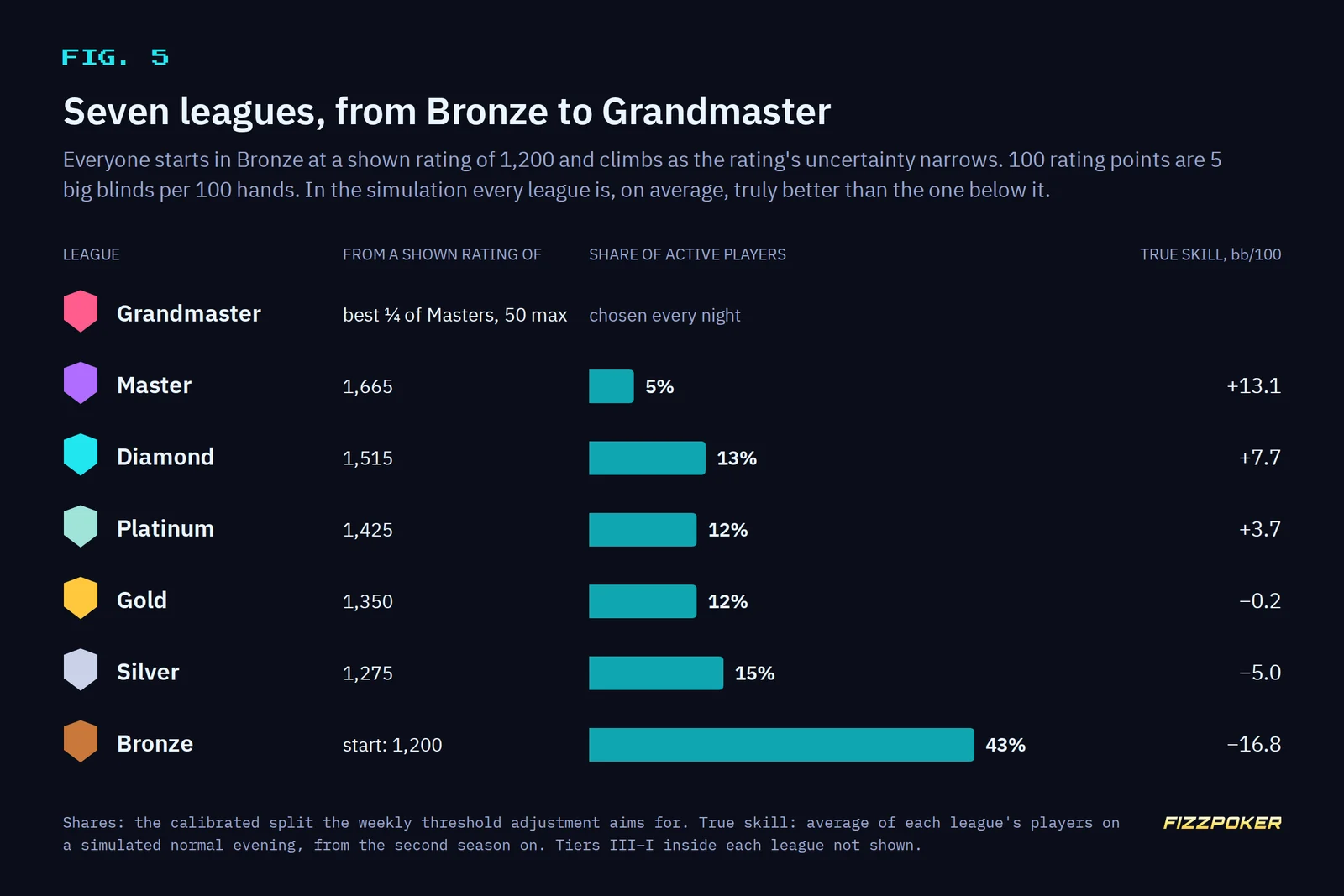
- Seven leagues — Bronze, Silver, Gold, Platinum, Diamond, Master and Grandmaster — with three tiers (III to I) inside each league up to Master. The live thresholds are on the league’s rules page.
- Fast placement. StarCraft II places you after five placement matches. Here the first league comes with the first rating update, after 8 hands. Everyone starts in Bronze, so the first promotion is the first success.
- Promotion at once, demotion with a buffer. You move up with the update that reaches the next tier or league. You drop a league only 50 points below its floor (a tier 20 below), and never during the first six updates — about an hour of play — after a step up. In the simulation the buffer cut demotions undone within a week from 5.7 to 0.3 per player and season.
- Master and Grandmaster. Master needs 500 hands in the last 30 days, otherwise Diamond I is shown until they are played. StarCraft II takes the top 200 players per region into Grandmaster; here it is the best quarter of the Masters, at most 50, chosen every night, each with 2,000 hands in the season.
- Seasons are calendar quarters. Leagues, points and the bonus pool start again; the rating carries over, and the badge shows Unranked until the first 8 hands of the new season.
- League points pay 2 per 10 hands, plus a bonus of up to 10 for a stretch that beat the rating’s expectation, measured in the player’s own standard deviations against their own average gain — so a maniac and a nit earn the same on average (3.7 and 3.4 points per ten hands in simulation, against 4.4 and 2.8 under the previous rule). A bonus pool, which StarCraft II veterans will remember, grows by 10 a day up to 400 and matches the points you earn one for one. Points never go down within a season.
- Thresholds recalibrate once a week, by at most 5 points, toward a calibrated split of 43 / 15 / 12 / 12 / 13 / 5 percent of active players from Bronze to Master — but only once 200 players are active.
One thing was deliberately not copied: matchmaking by rating. A small site cannot keep people waiting, so everyone who is online sits together, and rule 1 — comparing every result with what the ratings at the table expected — takes care of uneven tables. People always play people when they can; a house player only fills in for someone who would otherwise sit alone.
The simulations in numbers
The main run: 800 players, 90 days, tables of two to six, 8 seeds, every ladder fed the same hands.
| Ladder | All players (8+ hands) | 300+ hands | 1,000+ hands |
|---|---|---|---|
| Glicko-2, win/loss | −0.46 | −0.45 | −0.43 |
| Glicko-2, chip margin | −0.03 | −0.01 | 0.00 |
| Raw bb/100 | 0.46 | 0.57 | 0.66 |
| PokerGlicko | 0.70 | 0.73 | 0.77 |
Accuracy at equal volume
Compare players who have played about as much as each other and the gap shrinks: poker hides skill in short samples whatever the rating does. A large part of PokerGlicko’s overall lead comes from comparing players with different volumes fairly.
| Hands played | Players (avg.) | Raw bb/100 | PokerGlicko | Glicko-2, win/loss |
|---|---|---|---|---|
| 8 to 149 | 69 | 0.10 | 0.12 | −0.31 |
| 150 to 399 | 65 | 0.22 | 0.25 | −0.39 |
| 400 to 999 | 87 | 0.29 | 0.32 | −0.47 |
| 1,000 to 2,499 | 122 | 0.45 | 0.50 | −0.51 |
| 2,500 or more | 454 | 0.73 | 0.80 | −0.38 |
The simulated players are grinders — the median one played about 3,500 hands in the season. Real visitors play far fewer, which makes the cautious shown rating more important, not less.
Stress worlds
The minor rules were run again in worlds built for them: a third of the players at heads-up tables, three groups of different strength that rarely meet, and tables of two to nine. None added more than 0.02, which is why they are described as fairness rules, not accuracy rules.
| Ladder | Six seats | Separated groups | Heads-up heavy | Two to nine seats |
|---|---|---|---|---|
| Glicko-2, win/loss | −0.07 | −0.10 | −0.31 | −0.47 |
| Raw bb/100 | 0.41 | 0.39 | 0.45 | 0.42 |
| Big blinds against expectation | 0.60 | 0.59 | 0.63 | 0.61 |
| + all-ins at equity | 0.64 | 0.62 | 0.65 | 0.64 |
| + table size, own swing, opponents’ ± | 0.65 | 0.62 | 0.66 | 0.65 |
| + nightly re-grade (PokerGlicko) | 0.65 | 0.64 | 0.67 | 0.66 |
Against the league’s previous rating
Until 15 November 2026 the Open Poker League ran on a block rating with a pair cap. The lab ran its code unchanged next to PokerGlicko on the same hands.
| Measure | Previous rating | PokerGlicko |
|---|---|---|
| Rank accuracy, every seat a person, players with 500 hands | 0.43 | 0.80 |
| Active players from the second season on, normal evening | 0.73 | 0.77 |
| Of two players in different leagues, the higher is truly better | 85% (58% of pairs split) | 84% (75% of pairs split) |
| A season of chips fed through throwaway accounts | +182 to +639 points | 0 |
| The same from a real second account | +203 points | +114 points |
The previous rating was better in two places: the first weeks of a first season, and fewer league changes per season (1.3 against 1.9). It was also proven on the live site, which PokerGlicko still has to be.
What was tried and dropped
- Glicko-2’s volatility step. Identical ladders to three decimals at every setting; a fixed skill drift does the same job.
- A learned starting rating. The lab first learned a new player’s starting point every night. With house players met in only 0.2% of hands, that let their level drift by about 60 bb/100 in a season (115 in the worst one). With a fixed start the drift stays around 4. The start is now a fixed point of the scale.
- A soft reset between seasons. Letting earlier seasons count half or a quarter lowered accuracy for the whole following season and brought as many extra demotions as promotions. Ratings now carry over.
- A larger uncertainty discount. Subtracting more than three quarters of the uncertainty was tested and not adopted; three quarters is the setting the league runs.
- Scoring against a reference bot on the same deal. Cut the hands needed by only 10–60% and broke down for tight styles.
- Rating decisions instead of results. FizzPoker’s Fizz Score already grades decisions after each game against game-theory models. It stays out of the league: no engine grades a full multiway table correctly, and a ladder must not depend on a model’s blind spots. The league rates results; the Fizz Score is advice.
- A second format. Sit-and-gos were researched and set aside: the league has one game, 100 big blinds every hand, at tables of two to six.
How it compares with other poker rankings
The best-known ranking in poker is the Global Poker Index. According to its Wikipedia article, it ranks more than 450,000 live tournament players every week from their cashes in events with 32 or more entrants, weighting each result by finishing position, buy-in and age, and counting each player’s best results of the last three years. Its data comes from The Hendon Mob, the largest database of live tournament results. The World Series of Poker runs its own Player of the Year race over its events.
| Global Poker Index | Open Poker League | |
|---|---|---|
| What is ranked | Cashes in live tournaments | Every hand played |
| Who can be ranked | Players who cash in qualifying live events (32+ entrants) | Anyone with a free account |
| Cost to take part | Tournament buy-ins plus travel | Nothing: play chips, no purchases |
| Time to a first rank | A cash in a qualifying event | 8 hands, a few minutes |
| Luck | Results as they fell | All-ins counted at equity |
| Strength of opposition | Proxy: field size and buy-in | Opponents’ own ratings, hand by hand |
| Evidence used | Best results only (up to 5 per half-year, 3 years) | Every hand; a result counts half after 90 days |
| Shows its own uncertainty | No | Yes, a ± on every rating |
| Updates | Weekly | Every 10 minutes at the table, and nightly |
They answer different questions. The GPI ranks the best live tournament players in the world, competing for real money; the Open Poker League rates anyone who plays, from their first hands, for play chips. What the league adds is the combination: every hand rated rather than the best results, all-in luck removed, opponents weighed hand by hand, and an uncertainty shown next to every number.
What is still open
- Real hands. The table-size factors, the starting swing and the seat averages come from the simulated pool. With a few thousand real hands the question is which of them predicts a player’s next 500 hands better, and whether the ± holds — 68% of players within one uncertainty, 95% within two.
- House players heads-up. Their ratings were measured at full tables among themselves, and they now only ever play heads-up against someone who is alone. Their level against people in that format has to be measured from players who play both.
- Fair play beyond chip dumping. Soft play at a full table, shared hole cards and accounts that take turns were not simulated. The automatic checks and the device seating rule stay.
- Two people who only ever play each other. The rule that stops throwaway accounts cannot tell one from a friend: their ratings move during the evening and return at night. Hands against anyone else, house players included, count in full.
- Play chips change behaviour. People play looser when nothing is at stake. The league rates play-chip poker, and that is all it claims to rate.
- Scale. The nightly re-grade replays every stored hand of the last 460 days in one pass — milliseconds today, a checkpoint job at millions of hands.
The league is young — Season 1 started on 1 November 2026 and PokerGlicko went live on 15 November — so the most useful thing now is hands. If you know a poker ladder that does more of what is described here, or you find a way to break this one, the about page says where to find the developer.
Questions people ask
What is PokerGlicko?
PokerGlicko is the rating behind FizzPoker’s Open Poker League. It keeps Glicko’s idea of a rating plus an uncertainty, but scores every hand in big blinds against what the ratings at the table expected, counts all-ins at equity, learns each player’s own swing and ranks the ladder by the rating minus three quarters of its uncertainty.
Why not use Glicko-2 or Elo for a poker ladder?
Elo and Glicko-2 were built for two-player games that end in a win or a loss. Poker hands are won by many small pots and lost in a few big ones, so counting wins rewards calling stations and maniacs. In FizzPoker’s simulations a textbook Glicko-2 ordered players worse than chance at mixed tables of two to six.
Does a bad beat lower my Open Poker League rating?
Not the run-out. When the money goes in before the river, the Open Poker League counts each player’s share of the pot at that moment, so the cards that follow do not move a rating. Running into a better hand is luck of the deal and still counts; it evens out over many hands.
Why does everyone start in Bronze?
The Open Poker League ranks by what is proven: the shown rating is the rating minus three quarters of its uncertainty. A new player’s uncertainty is large, so everyone starts at exactly 1,200 in Bronze and climbs as the ± narrows. A strong player climbs faster than a weak one.
How many hands does the Open Poker League need to know my level?
The ± starts at 640 points and halves after about 9,258 hands at a six-seat table. Poker’s luck sets that pace for any rating system. A first league comes after 8 hands, but a league held on a few hundred hands is provisional.
Are house players bots, and do they count?
Yes. House players are labelled computer players with four levels and fixed, measured ratings. A house player sits down only for someone who has no other person to sit with and gives the seat up as soon as a person is waiting. Results against them count toward your rating; they are never on the leaderboard.
Can someone farm rating with a second account?
Not without being noticed. The Open Poker League’s guard takes hands out of both ratings when chips flow one way between two accounts beyond chance, counts hands for less against an account that mostly plays with you, and lets no single opponent supply more than 15% of a rating. In simulation, a season of chips fed through throwaway accounts moved the receiving rating by 0 points.
Does the Open Poker League use the Fizz Score?
No. The league rating is results-based: big blinds won against what the ratings expected. The Fizz Score is FizzPoker’s separate post-game decision review against game-theory models; it is advisory and is not used to rank anyone on the ladder.